
Tuesday morning I was supposed to be doing PM diligence the hard way.
Three property management companies in Boise. Each one a day’s work to actually evaluate. Phone calls to the references they’d named. Online reviews. Their financial proposals. Their contract terms. Their lease-up history. The standard reps and warranties. The kind of stuff you have to put side by side to know.
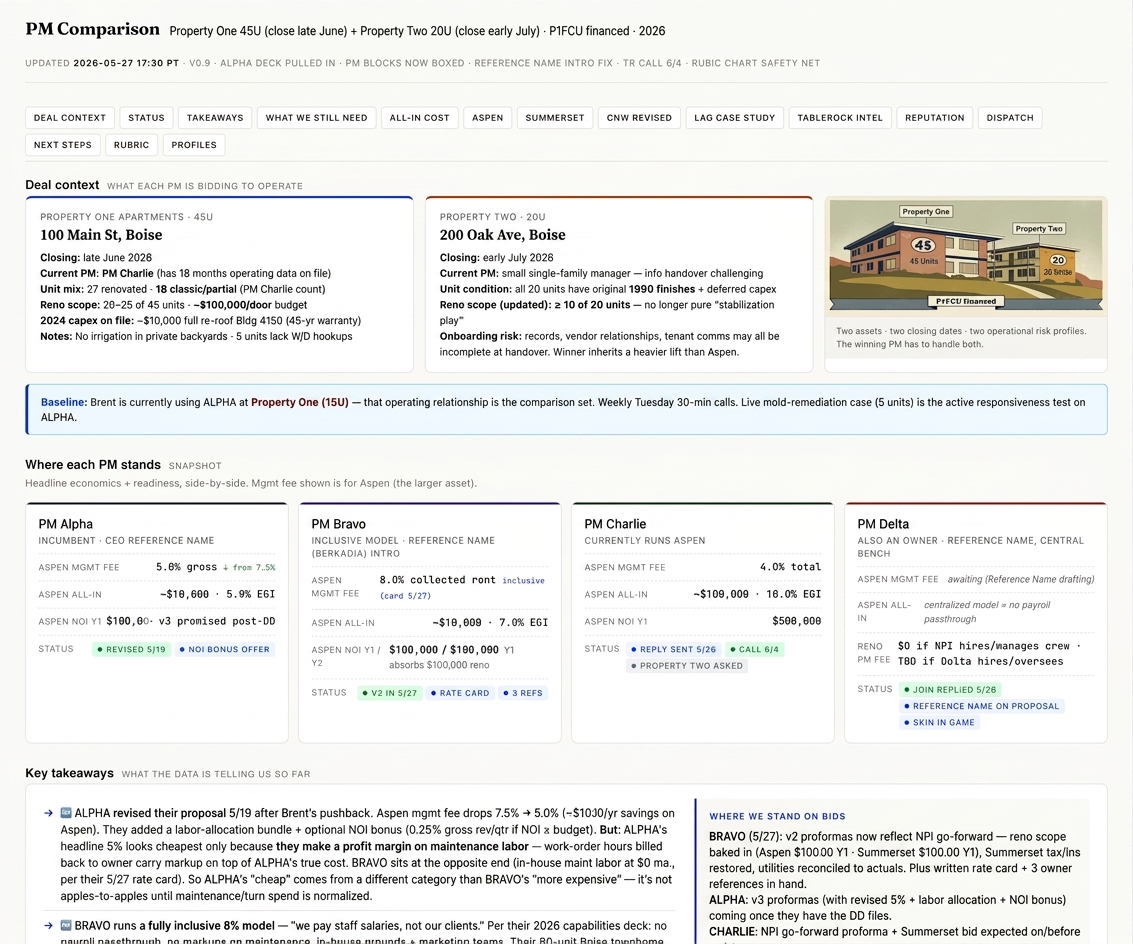
I asked Claude Code to build me a dashboard instead.
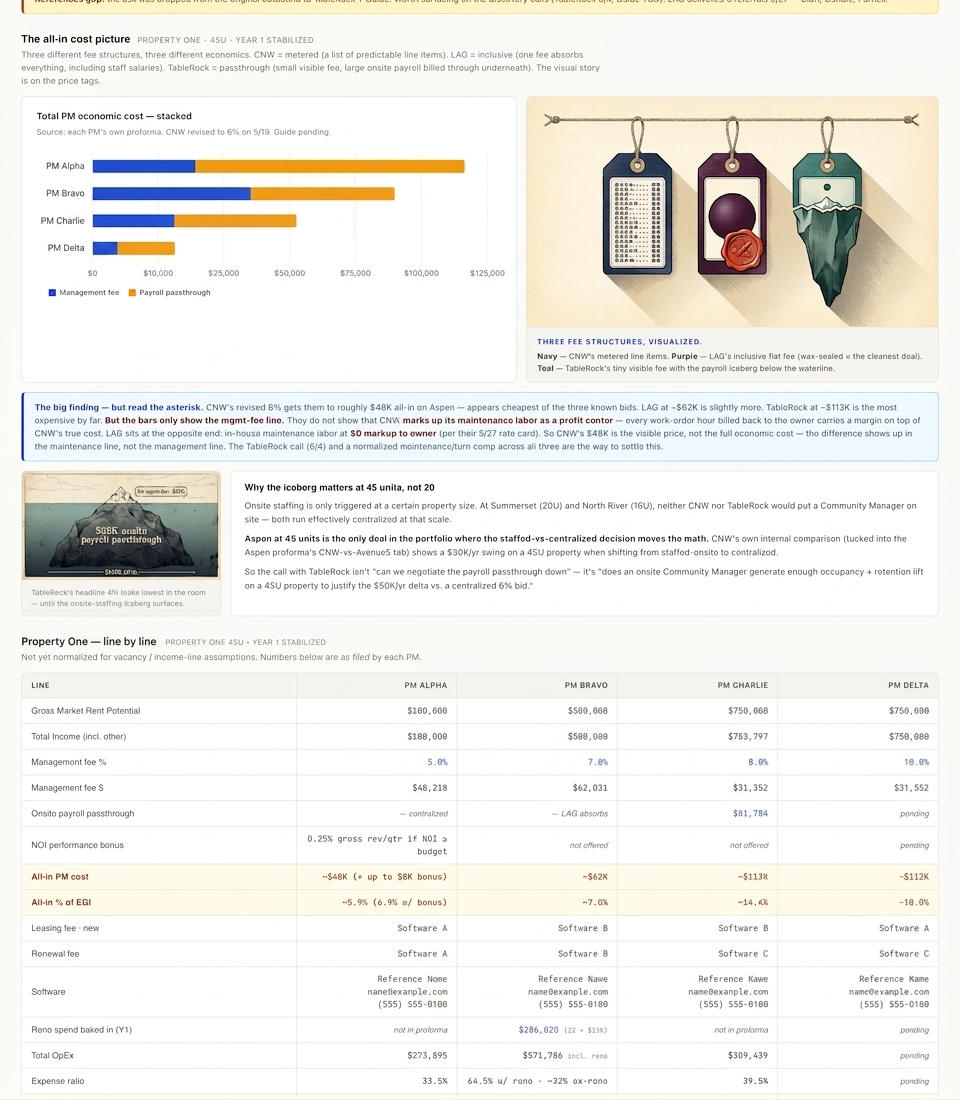
Standalone HTML, single page. One column per PM. Color-coded grid for the things that actually mattered: fee structure, ancillary income splits, lease-up performance on comps in their portfolio, tenant retention, standard reps and warranties, how they handle late rent and evictions. Reviews scraped from the public web. Financials parsed from the PDFs they’d already sent me. Contract terms extracted from the agreements they’d attached.
The dashboard was running before my coffee was cold.
What actually changed
The point isn’t that AI is fast. Fast is the by-product. The point is that AI changes what’s worth comparing.
When the diligence is hard, you compare three vendors and pick the best one of the three. That’s the work most operators do. It’s fine. It produces a decent answer.
When the diligence is cheap, you compare ten and find the one that actually fits.
Different jobs. The first one is hiring the best PM you got introduced to. The second one is hiring the best PM in Boise. The output of each is a real estate portfolio that performs differently across a ten-year hold.
Most operators are still doing the first job and calling it the second one.
Why this is the work
This is what I mean when I say NPI runs on AI. We don’t staff up the way most real estate investment firms do because the analyst layer is AI now. Deal screening. Underwriting. PM diligence. PSA review. Document intelligence. The work that used to require a four-person ops team gets done with one operator and a Claude Code session.
The overhead doesn’t come out of the deal. The LP returns the difference.
For your own business, the same logic applies. The diligence work that used to take you three days now takes you 30 minutes. Which means you can do ten times the diligence in the same week. Which means the decisions you make are made on better data than the decisions your peers are making.
Two years of that compounding and the gap is structural.
How to start
If you’re an operator wondering where to start with this, the same habit shows up in how I underwrite. The memo pack is nine pages of the actual diligence I ran on a building I now own. Free at neelypi.com/memo.
The PM dashboard above is Secret 8 (find diligence gaps before the buyer does) and Secret 19 (read any pitch in 90 seconds and tell you what’s missing) applied to a vendor selection problem instead of a buyer one. Same skill, different target.
Build it once. Run it forever.
A short personal note from me most Fridays about what actually happened that week. Subscribe to the Friday letter.