
This isn't tax advice. It's a primer for the conversation with your CPA.
On October 21, an engineer walked Aspen with our property manager and a clipboard. His numbers were in my inbox the next morning.
It's called a cost segregation study. It costs $5,000, and for our investors it's probably the most valuable piece of paper this deal produces all year.
A building isn't one thing
The IRS lets you write off an apartment building a little at a time, over 27.5 years. But a building is also dishwashers, carpet, cabinets and a parking lot, and those wear out a lot faster. The tax code lets you write those pieces off faster too. You just have to count them first. That's the study.
What we actually bought
Red pieces get written off in 2026. Blue pieces take 27.5 years. Hover any marker.
Written off in 2026
- 1Appliances
- 2Cabinets and countertops
- 3Kitchen sinks
- 4Carpet and vinyl floors
- 5Ceiling fans
- 6Window blinds
- 7Parking lot and sidewalks
- 8Carport
- 9Landscaping
- 10Fencing
- 11Storm drains
Written off over 27.5 years
- ARoof
- BExterior walls and windows
- CDrywall and paint
- DPlumbing lines
- EWiring and lighting
- FHeating and cooling
- GFoundation and framing
Plumbing, drywall, paint and the roof are part of the structure, so they stay on the long schedule. What moves fast is everything that wears out or gets replaced: the kitchen, the floors, the parking lot, the landscaping. Add those up and you get the split below.
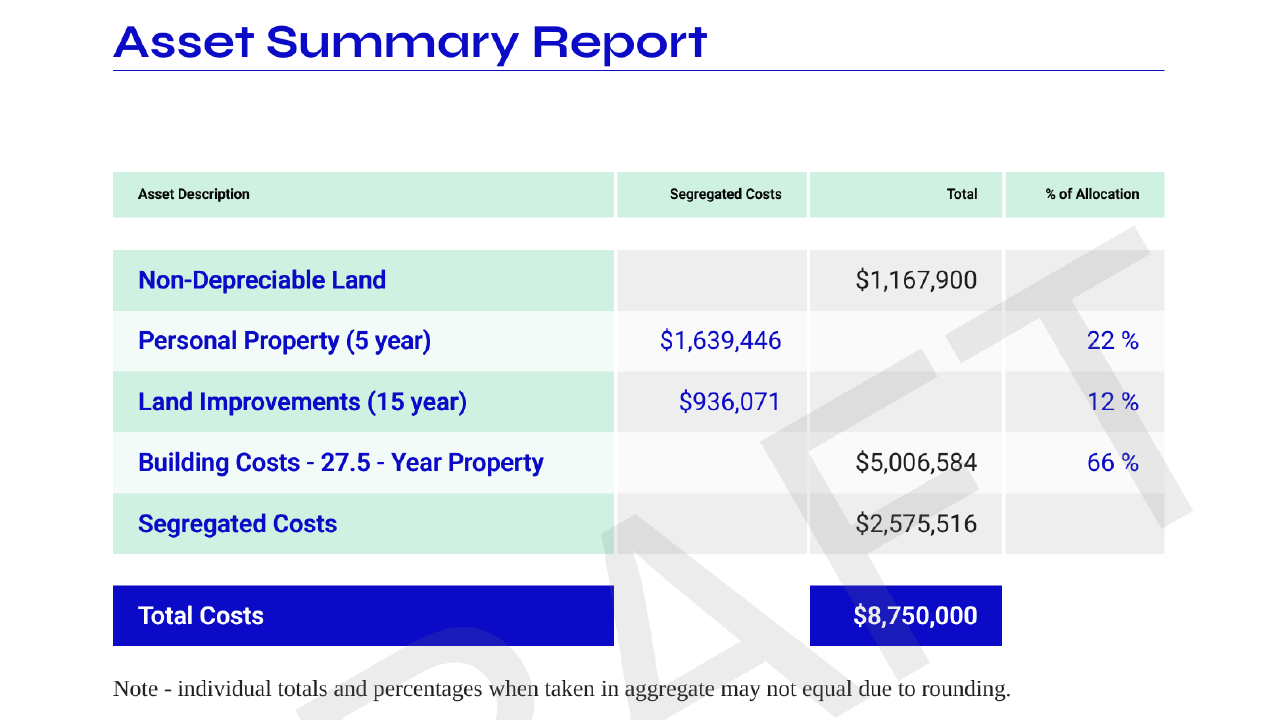
Where the $8.75 million purchase price went
Hover a section for detail
Land
Never depreciates. It comes off the top.
Fast
Appliances, cabinets, flooring, paving, landscaping. Written off in 2026.
The structure
Walls, roof, foundation. A small slice every year for 27.5 years.
Without the study, all of that red would sit in the blue. Same building. Very different first year.
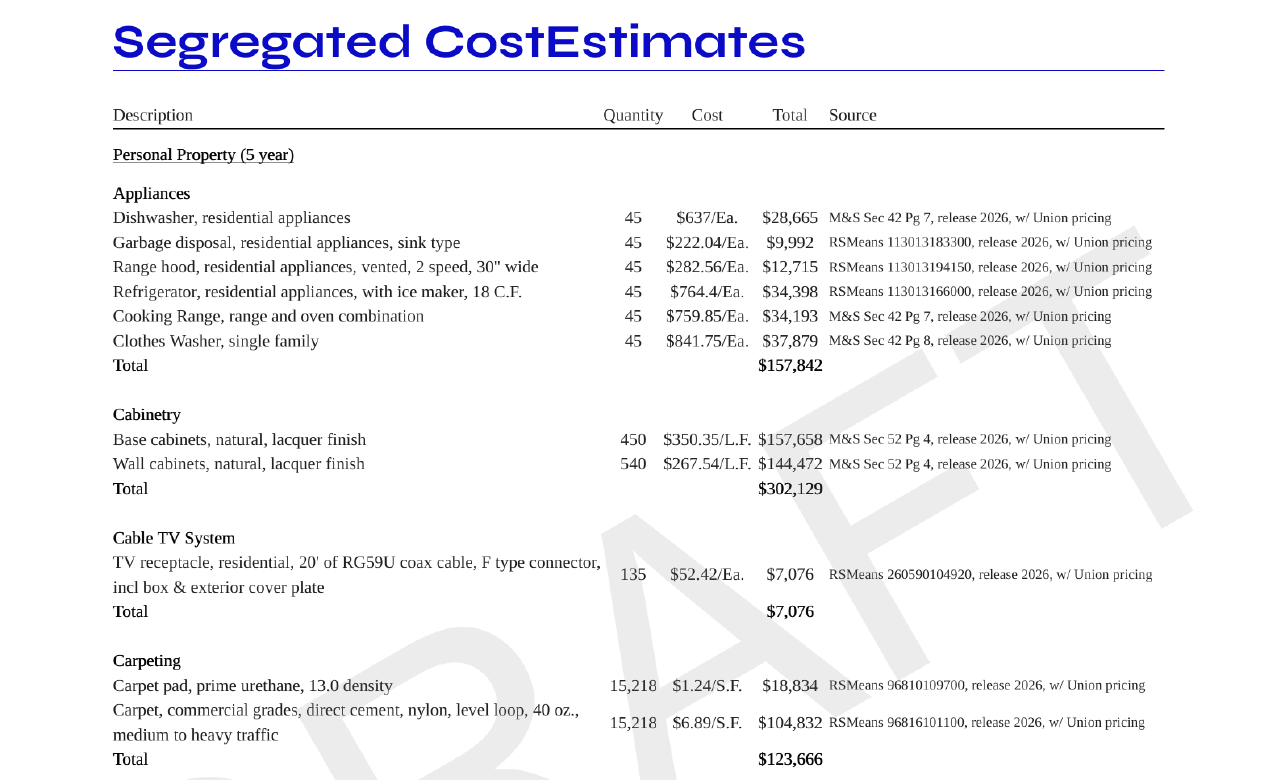
He counted
This is the part I wanted you to see. The number is a count. Every line cites the standard construction cost manual it came from, so an auditor can retrace it.
What it changes in year one
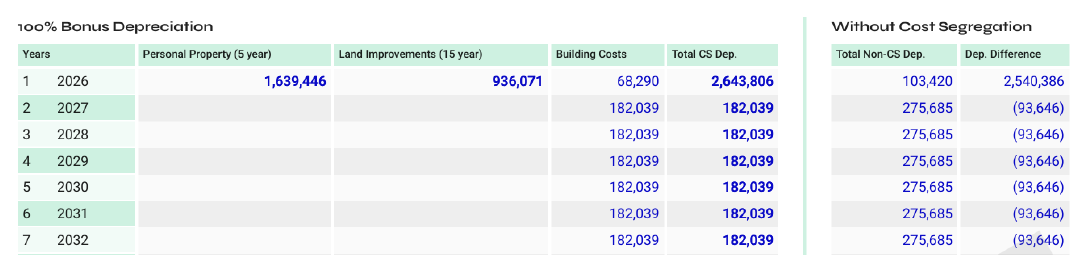
Under current law, those fast pieces can be written off all at once in the year the building goes into service. Aspen went into service August 28, 2026.
Depreciation the building produces in 2026
Same building, same price
About 25 times the first-year write-off, from a $5,000 report.
What it means if you own Aspen with us
The depreciation passes through to our investors in proportion to what they put in. It works out like this.
About 89 cents of first-year depreciation for every dollar invested.
We don't buy buildings for the depreciation
If the tax piece were the only reason, I wouldn't have bought Aspen, and I wouldn't have put my own money in it. We bought it because the rents in place were below market, we have a plan to close that gap as units turn over, and it pays investors monthly. The depreciation sits on top of all that.
See the full Aspen deal →What decides what it's worth to you
The depreciation is the same for every investor. What it does on each return isn't. Three things drive it.
Your bracket
The $88,700 reduces taxable income. Your bracket sets what that's worth in dollars.
Your passive income
For most investors it's a passive loss. It offsets other passive income, like rentals, and anything unused carries forward until the building sells.
The eventual sale
When the building sells, part of the depreciation comes back as recapture. The value is in the timing, and what the money does in between.
The fund allocates the number. Your CPA applies it.
Talking to your CPA before December 31?
I wrote a one-page summary for exactly that conversation. Hand it to your CPA, or book 30 minutes and I'll walk you through it.
I planned for 60 cents. It came in at 89.
When I underwrote Aspen, I told our investors to expect about 60 cents of first-year depreciation for every dollar they put in. I picked a number I was confident we'd beat.
First-year depreciation per dollar invested
What I forecast vs. what the study found
That's how I try to underwrite every deal. Conservative on the things I can't control, so when the real number shows up, it lands in our investors' favor.
See the other pages from the study
Thanks,
Brent
This is not tax advice. Talk to your CPA about your situation. The $100,000 example assumes the fund's full member capital of $2,979,986.
A short personal note from me most Fridays about what actually happened that week. Subscribe to the Friday letter.